

| mobile_3 App Name | Cafeland – Restaurant Cooking |
| play_arrow Google Play Link |  |
| tag Version | 2.79.3 |
| data_usage Size | 214 MB |
| folder Category | Simulation |

Mod Info
– Unlimited Money
Introduction
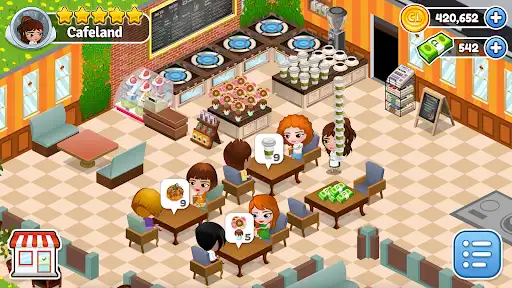
Cafeland is an Android restaurant simulation game built around a simple idea: start with a modest café and gradually turn it into a place where customers want to eat. You take care of the kitchen, serve food, arrange the dining area, and decide how your restaurant should look.
The game does not put you under constant pressure. Instead, it gives you a steady stream of small jobs. You cook dishes, wait for them to finish, serve customers, and use the results to improve the café. That rhythm makes it easy to play for a few minutes and return later when you have more time.
There is also a strong decorating side to the experience. Furniture, counters, tables, kitchen equipment, and decorative objects let you shape the restaurant around your own preferences. The café becomes more than a backdrop for the cooking. It becomes the main thing you are building.
Cooking is about planning ahead
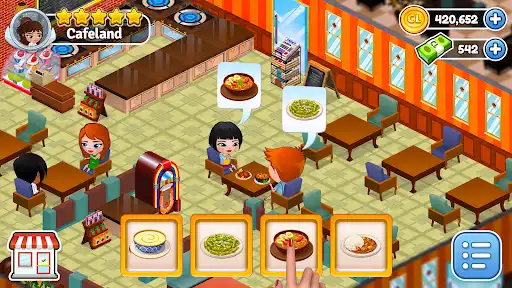
The cooking system gives Cafeland much of its day-to-day rhythm. Different dishes take different amounts of time, so deciding what to prepare next becomes part of the routine.
A quick dish can keep customers moving when the café is busy. A longer recipe can be started before leaving the game so that it is ready when you return. This creates a gentle form of planning without turning the game into a complicated management simulator.
Food mastery adds another reason to pay attention to the dishes you prepare. As you become more familiar with recipes, they can become more useful to the restaurant. The result is a sense of gradual improvement rather than a series of disconnected cooking tasks.
The satisfaction comes from seeing preparation turn into progress. You start something in the kitchen, wait for it to be ready, serve it, and then use what you earn to keep the café moving forward.
Running the café at your own pace
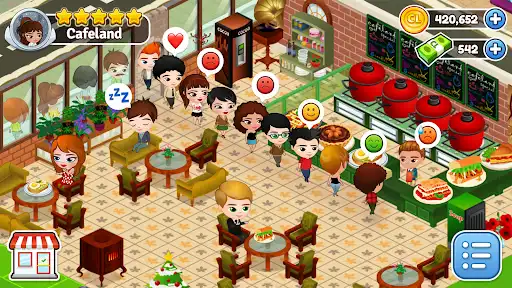
The restaurant management is deliberately approachable. You are not trying to control every customer or solve a difficult economic puzzle. Instead, the game asks you to make a series of small choices about what the café needs next.
You might spend your earnings on a useful piece of equipment. You might improve the dining area instead. Sometimes the better choice is simply to prepare more food and build up your resources before making a larger change.
That creates the main decision-making loop. You are always balancing immediate needs against longer-term improvements. A restaurant that looks better is enjoyable to build, but kitchen equipment and food preparation also affect how smoothly the café operates.
The pacing helps keep these decisions manageable. There is enough going on to give you a reason to check the restaurant regularly, but the game does not demand your attention every second.
Decorating becomes part of the game
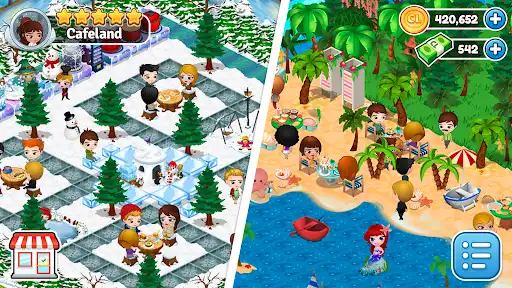
For players who enjoy customization, the café itself can become the biggest attraction. Cafeland gives you plenty of freedom to arrange the restaurant rather than simply placing everything wherever there is an empty space.
You can change the appearance of the dining area and create a particular atmosphere through furniture and decorations. A practical layout can make the café feel organized, while a more decorative approach can turn it into a personal project.
This also changes the way progression feels. Unlocking or buying a new item is not only about improving a number. It can give you another way to change the appearance of your restaurant.
The result is a pleasant contrast between management and creativity. One moment you are thinking about what food should be prepared. The next, you are moving furniture around because the room does not quite look the way you want.
A colorful, relaxed restaurant world
Visually, Cafeland uses a bright and stylized presentation that suits its casual approach. Food, furniture, customers, and kitchen equipment are presented with a playful look rather than attempting to simulate a real restaurant in detail.
That style keeps the game easy to read on a phone screen. The café is filled with objects to notice, but its colorful presentation prevents the experience from feeling overly serious.
The overall mood is similarly relaxed. There is no dark storyline or dramatic conflict driving the experience. The appeal comes from watching a small restaurant develop over time and deciding what you want it to become.
Why the routine can keep you coming back
The strongest part of Cafeland is its sense of momentum. Progress is broken into manageable steps, so there is usually another small improvement waiting after the current one.
Cooking supports that feeling. Decorations support it too. Each activity feeds into the next, giving the game a dependable routine without requiring complicated controls.
It works particularly well for players who enjoy games where progress happens gradually. You can check the café, prepare some food, make a few changes, and leave. When you return, there is usually something else to take care of.
That makes Cafeland less about winning a single big challenge and more about maintaining a restaurant that slowly becomes your own. The cooking provides the routine, the management provides the decisions, and the decorating gives you a reason to care about the space you are creating.